
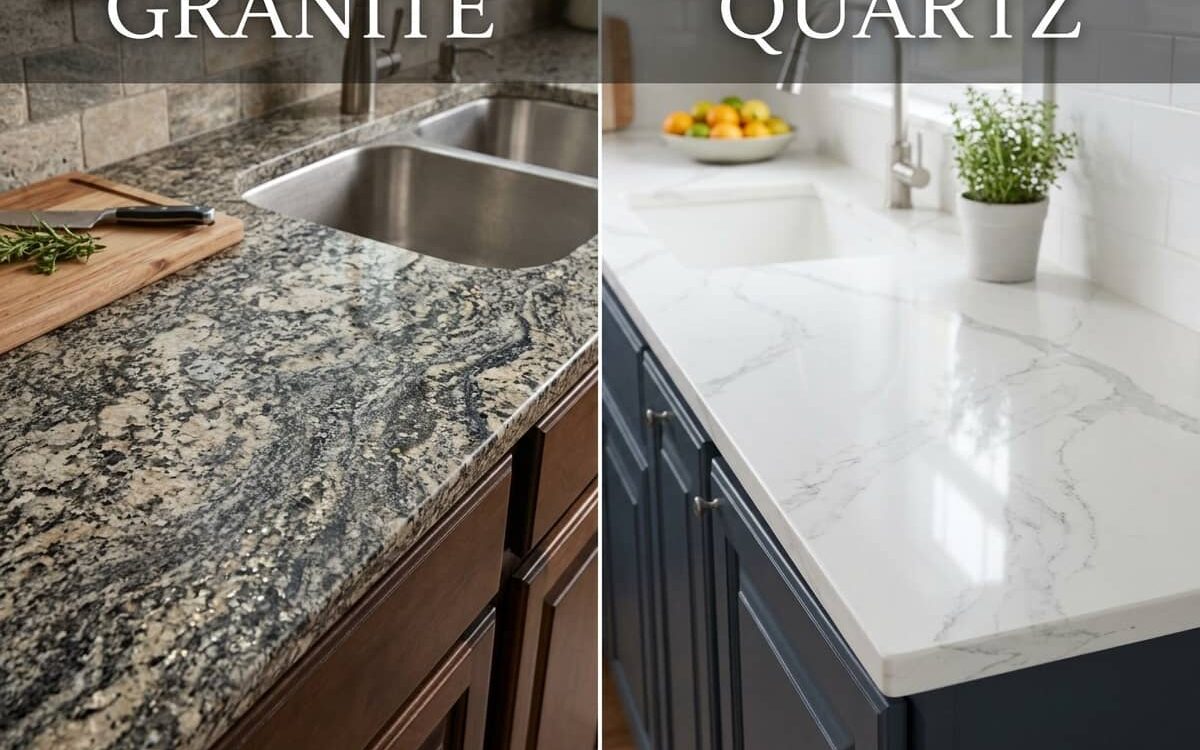
Every countertop looks flawless in a showroom. The real test starts the first week in your kitchen – when a sheet pan comes out of a 425°F oven, someone leaves a glass of red wine on the island overnight, and a cast-iron skillet slips out of a wet hand. That’s where the granite vs quartz countertops decision actually gets made.
Most granite vs quartz countertops comparisons stop at “granite is natural, quartz is engineered.” That’s true, but it doesn’t tell you what happens when real life hits the surface. This guide takes a different approach. We put granite vs quartz countertops through the four things that actually wear a kitchen down – heat, stains, scratches, and daily use – and explain why each material reacts the way it does, so you can match the stone to the way you really cook and clean.
At Q Kitchen & Bath, we design and build kitchens across Orange County and Southern California, and the granite vs quartz countertops choice is one of the decisions our clients think hardest about. Here’s the honest, practical breakdown we walk them through.
Key takeaways: granite vs quartz countertops in daily use
- Heat: granite tolerates brief contact with hot cookware far better than quartz, whose resin binder can scorch, yellow, or crack.
- Stains: quartz is non-porous and never needs sealing; granite resists stains well when it’s properly sealed.
- Scratches: both are very hard and resist everyday knife and utensil contact – neither should be used as a cutting board.
- Chips: quartz’s slight flexibility helps protect edges; granite corners can chip under a hard impact, though repairs are usually simple.
- Daily wear: both last for decades with gentle cleaners. Harsh chemicals hurt granite’s sealer and quartz’s resin alike.
Granite vs Quartz Countertops at a Glance: The Daily-Wear Scorecard
If you only have a minute, this scorecard sums up how granite vs quartz countertops perform under everyday kitchen stress.
| Daily-wear factor | Granite | Quartz | Edge |
| Hot pans and bakeware | Tolerates brief contact; thermal shock still possible | Resin can scorch, discolor, or crack | Granite |
| Food and drink stains | Resistant when sealed; porous when not | Non-porous; resists most stains without sealing | Quartz |
| Knife and utensil scratches | Very hard; dark polished slabs can show scuffs | Very hard; resin surface may show fine marks | Tie |
| Chips on edges and corners | Brittle corners can chip under impact | Slight flexibility helps protect edges | Quartz (slight) |
| Harsh cleaners | Strip the protective sealer | Damage the resin binder | Tie |
| Sunlight and UV | UV-stable | Can yellow or fade over time | Granite |
| Routine upkeep | Periodic resealing | Wipe-and-go | Quartz |
The pattern is clear: in the granite vs quartz countertops scorecard, granite wins on heat and sunlight, quartz wins on stains and upkeep, and the two run nearly even on scratches. To understand why, it helps to look at what each slab is made of.
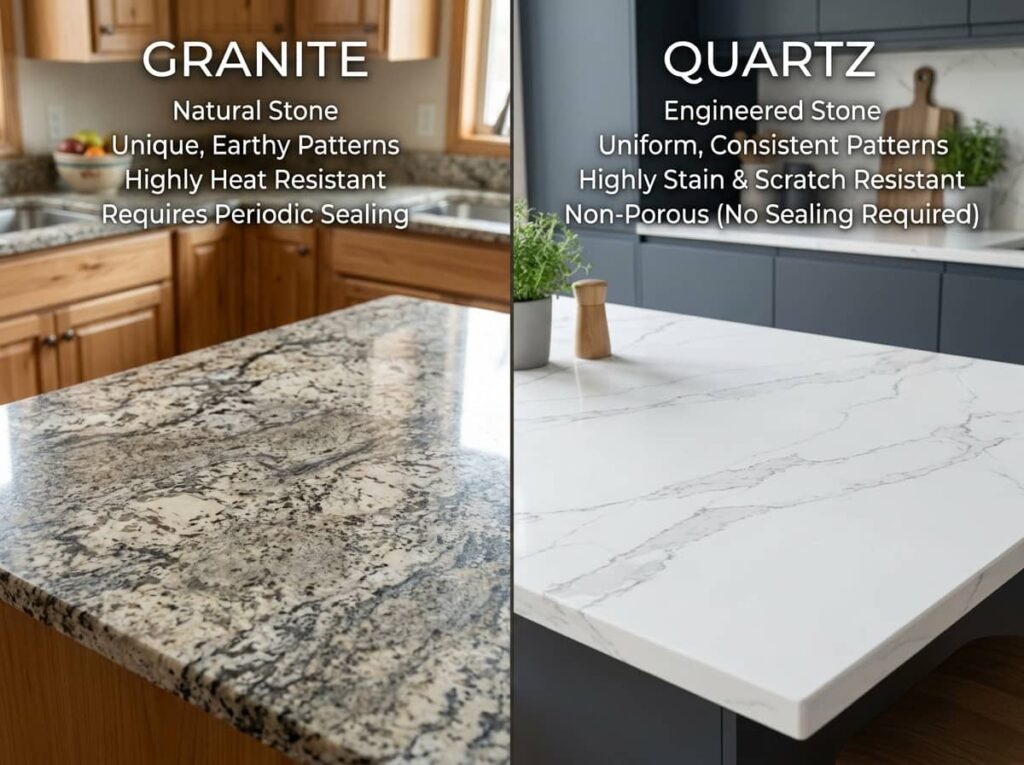
What Makes Granite and Quartz Behave Differently
The performance gap in granite vs quartz countertops isn’t marketing – it comes straight from how each material is built.
Granite: Interlocking Minerals With Natural Pores
Granite is an igneous rock that formed as magma cooled slowly underground. It’s a tightly interlocked mix of minerals – mostly feldspar and quartz, with smaller amounts of mica and others. According to the National Park Service, quartz rates a 7 on the Mohs hardness scale and potassium feldspar a 6, while mica is soft enough to scratch with a fingernail. That mix explains a lot about how granite wears: an extremely hard surface overall, with tiny pores and occasional natural fissures between crystals.
Because granite was born under intense heat and pressure, it has no plastic or resin to melt. Its weak points are porosity (which lets liquids soak in) and brittleness (which lets corners chip).
Engineered Quartz: Crushed Stone Held Together by Resin
Quartz countertops are engineered stone – crushed quartz aggregate bound with polymer resins and pigments, then pressed and cured into slabs. Researchers at the CDC’s National Institute for Occupational Safety and Health (NIOSH) describe these “quartz surfacing” products as quartz aggregate held together with a resin binder.
That resin is the key to everything. It fills every gap between mineral particles, which is why quartz is non-porous and stain resistant. It also adds a little flexibility, which helps edges resist chipping. But resin is a polymer, and polymers react to high heat, UV light, and harsh chemicals in ways natural stone does not. Almost every difference in the granite vs quartz countertops debate traces back to this one ingredient.
Don’t confuse quartz with quartzite. Quartzite is a natural metamorphic stone, not an engineered product. It behaves more like granite (heat-tolerant, needs sealing) than like engineered quartz. Always confirm which one you’re looking at before you weigh granite vs quartz countertops.
Heat Resistance: Can You Put a Hot Pan on Granite or Quartz?
Heat is where granite vs quartz countertops differ the most – and where the most expensive mistakes happen.
How Granite Handles Hot Cookware
On heat, the granite vs quartz countertops comparison clearly favors natural stone. Setting a hot saucepan down for a moment is very unlikely to hurt it, which is why granite remains a favorite of serious home cooks and anyone who moves fast between stove and counter.
That said, “heat resistant” isn’t “heat proof.” Two situations can still cause trouble:
- Thermal shock: a very hot pan placed on a cold slab – especially near a seam, a sink cutout, or a natural fissure – can stress the stone.
- Sealer damage: repeated high heat in the same spot can break down the sealer, leaving that area more vulnerable to stains.
A trivet near the range is still a smart habit, even with granite. It just isn’t mandatory every single time.
Why Quartz Countertops Need Trivets
With quartz, trivets aren’t optional. The resin binder can’t take the temperatures that come straight off a burner or out of an oven. Major quartz manufacturers instruct owners to use trivets or hot pads under hot cookware and to avoid sudden temperature changes, which can cause cracking.
Heat damage on quartz usually shows up as:
- Yellow or brown scorch marks where the resin has burned
- Cloudy or dull patches where the surface finish has changed
- Hairline cracks from thermal shock, often near cutouts or seams
Here’s the frustrating part: scorched resin generally can’t be scrubbed or sealed away, and heat damage is commonly excluded from manufacturer warranties. Read the care section of your warranty before installation, not after the first accident.
Heat Habits That Protect Either Countertop
No matter which side of the granite vs quartz countertops question you land on, these habits keep your surface looking new:
- Keep a pair of trivets permanently parked next to the cooktop and oven.
- Put slow cookers, air fryers, toaster ovens, and electric griddles on a heat-resistant mat.
- Let pans cool on the stovetop instead of moving them straight to the counter.
- Plan a heat-safe landing zone – like a stainless steel or porcelain inset – into your kitchen design if you cook a lot.
Stain Resistance: Which Countertop Shrugs Off Spills?
When it comes to stains, the granite vs quartz countertops scorecard flips in quartz’s favor. Still, granite can be every bit as practical with the right care – and quartz isn’t completely stain-proof.
Granite Stains and the Role of Sealing
Granite’s porosity varies widely from slab to slab. Dense, dark granites absorb very little; lighter, more open-grained stones can soak up oil and pigment within minutes. A quality penetrating sealer fills those pores and buys you time to wipe up spills.
The most common granite stains in a working kitchen are:
- Oil and grease (cooking oil, butter, salad dressing), which darken the stone
- Organic stains (coffee, tea, wine, berries), which leave brown or pinkish marks
- Water rings near the faucet, often from hard-water minerals rather than true staining
Run the water test. Drip a little water on the surface and wait about 10–15 minutes. If the stone darkens, the sealer is wearing thin and it’s time to reseal. Many slabs need resealing every one to three years, while some very dense granites rarely need it. Your fabricator can tell you what to expect from your specific stone.
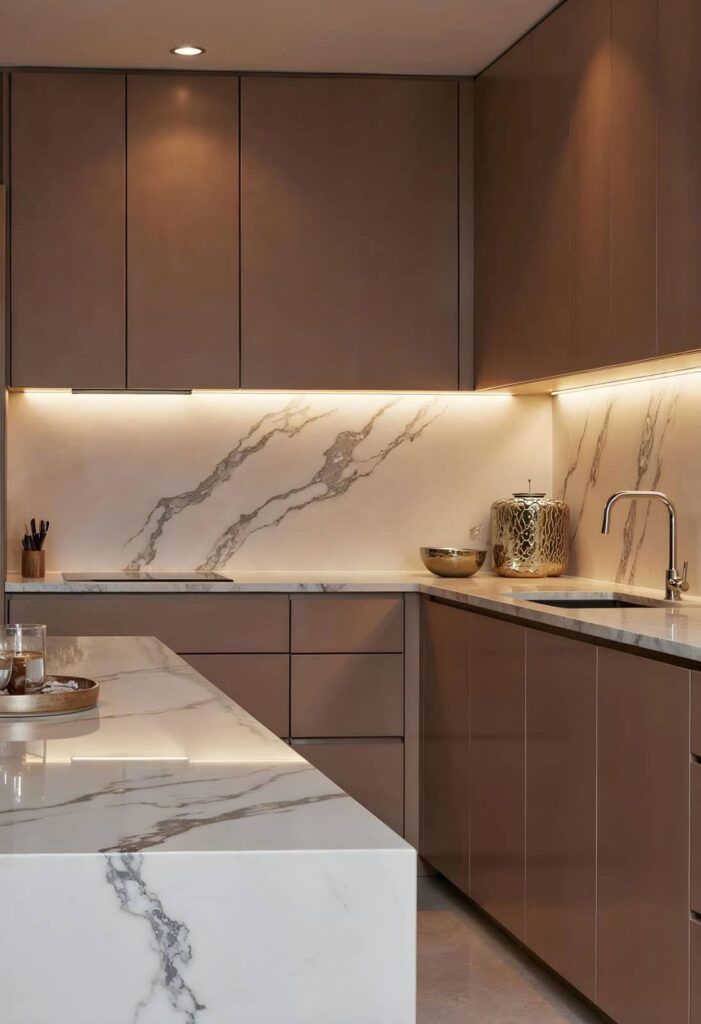
Quartz Countertop Stains: Non-Porous, Not Stain-Proof
Because the resin fills every gap, liquids sit on top of quartz instead of soaking in. Wine, coffee, oil, and tomato sauce wipe away easily, and you’ll never need to seal it. That’s a big reason busy families lean toward quartz in the granite vs quartz countertops matchup.
But “non-porous” doesn’t mean nothing can mark it. Strong pigments – turmeric, permanent marker, hair dye, and some food colorings – can leave surface discoloration, especially on white and light gray quartz if left to sit. Prompt cleanup is still the rule.
Stain Removal Guide for Granite vs Quartz Countertops
| Stain | Granite | Quartz |
| Cooking oil or grease | Baking soda and water poultice; cover and let it draw out the oil overnight | Warm water and dish soap; a non-abrasive cleaner if needed |
| Coffee, tea, or wine | Wipe promptly; stone-safe stain remover for set-in marks | Wipes clean in most cases; non-abrasive cleaner for residue |
| Dried food | Plastic scraper, then pH-neutral cleaner | Plastic scraper, then mild soap and water |
| Marker or dye | Stone poultice; professional help if stubborn | Manufacturer-approved cleaner; avoid solvents and bleach |
| Hard-water rings | Stone-safe hard-water remover (avoid vinegar) | Mild, non-abrasive cleaner |
When in doubt, test any cleaner in an inconspicuous spot first, and follow the care guide from your slab’s manufacturer or fabricator.
Scratch and Chip Resistance: Knives, Cast Iron, and Everyday Impacts
On scratches, the granite vs quartz countertops comparison is closer than most people expect.
Scratches: Hardness Is Only Part of the Story
A typical steel knife blade sits around 5.5 on the Mohs scale – softer than both the quartz crystals in granite and the quartz aggregate in engineered slabs. That’s why both surfaces shrug off normal slicing, utensil contact, and dishes sliding across them. It’s also why you’ll dull your knives quickly if you cut directly on either one.
What does leave marks:
- Grit and sand trapped under a heavy pot or appliance and dragged across the surface
- Ceramic bowls and stoneware with unglazed bottoms, which can be abrasive
- Diamond rings and metal pans dragged with pressure
Finish and color matter as much as the material. Dark, highly polished surfaces – in either granite or quartz – show fine scuffs more readily than lighter, honed, or leathered finishes. If you’re choosing a jet-black polished slab, expect to see more surface marks under raking light than you would on a speckled or matte surface.
Chips, Cracks, and Vulnerable Edges
Chips happen at edges and corners – near the dishwasher, the sink, and the spot where everyone sets down grocery bags. Here, quartz vs granite countertops tilts slightly toward quartz: the resin gives it a touch of flexibility, so it tends to resist chipping from everyday knocks.
Granite is harder but more brittle. A heavy cast-iron pan dropped on a square corner can pop out a small chip. The good news is that small chips in granite are usually repairable with color-matched epoxy by an experienced fabricator, and the natural pattern helps hide the fix. Quartz chips can also be repaired, though matching a solid, uniform color can be harder to make invisible.
To reduce chipping on either material:
- Choose a softened, eased, or rounded edge profile instead of a sharp square edge in high-traffic zones.
- Don’t stand or kneel on the counters, especially near overhangs and cutouts.
- Make sure overhangs are properly supported with brackets or corbels.
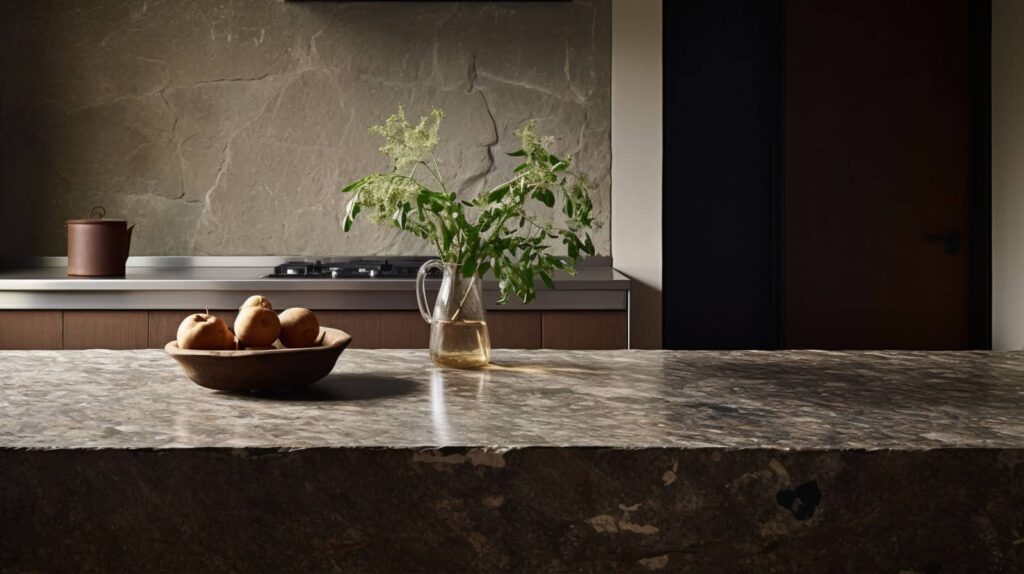
Daily Wear and Long-Term Durability of Granite vs Quartz Countertops
Heat, stains, and scratches are the dramatic moments. Daily wear is the slow, quiet stuff that determines how your countertop looks in year ten.
Cleaning Products and Surface Damage
The fastest way to age either surface is the wrong cleaner. In the granite vs quartz countertops comparison, each material has its own chemical weak spot:
- Granite: acidic cleaners (vinegar, lemon, many all-purpose sprays) and harsh degreasers wear down the sealer, leaving the stone more absorbent over time.
- Quartz: bleach, oven cleaner, paint strippers, and high-pH products can attack the resin and cause discoloration that may not be reversible.
For both, the daily routine is the same: warm water, a few drops of mild dish soap, and a soft microfiber cloth. Add a pH-neutral stone cleaner for granite or a manufacturer-approved surface cleaner for quartz, and skip abrasive scrub pads entirely.
Seams, Sinks, and High-Traffic Zones
Seams are where most long-term wear shows up on granite vs quartz countertops. A well-fabricated seam is tight, level, and filled with color-matched epoxy. Poorly executed seams can lift, collect grime, or crack under thermal stress. Quartz’s consistent pattern can make seams easier to blend; granite’s movement requires careful slab layout to keep veining continuous.
The area around an undermount sink takes a beating too – constant water, soap, and impacts from heavy pots. Proper support, a quality sink mount, and a sealed or well-maintained cutout edge make a real difference. This is where fabrication quality matters as much as material choice.
Sunlight and Fading
Here’s a granite vs quartz countertops factor that matters in sunny Southern California. Granite is UV-stable. Quartz’s resin and pigments can yellow or fade with prolonged sun exposure, which is why many manufacturers don’t recommend engineered quartz outdoors. Indoors, a quartz countertop beside a large, west-facing window may slowly develop uneven color over many years. If you’re also planning an outdoor kitchen, granite or porcelain is generally the safer pick.
Granite vs Quartz Countertops Maintenance: A Realistic Yearly Routine
Neither surface is high-maintenance, but the routines differ. Here’s what a year of care really looks like.
Granite
- Daily: wipe with warm water and mild soap; dry spills promptly.
- Weekly: pH-neutral stone cleaner on heavy-use zones.
- Every few months: run the water test near the sink and cooktop.
- Every 1–3 years (as needed): reseal – usually a simple job that takes well under an hour.
Quartz
- Daily: wipe with warm water and mild soap.
- Weekly: non-abrasive, manufacturer-approved surface cleaner.
- Always: trivets under hot cookware and cutting boards for prep.
- Never: seal it, use bleach or oven cleaner, or set hot pans down directly.
Put simply, the granite vs quartz countertops maintenance trade-off is this: granite asks for a few minutes of attention each year, while quartz asks for daily discipline around heat and harsh chemicals.
Granite or Quartz Countertops: Which Fits Your Kitchen Habits?
The best way to settle the granite vs quartz countertops question is to look honestly at how you use your kitchen.
| If you… | Lean toward | Why |
| Cook often and move pans fast | Granite | Better heat tolerance |
| Have young kids and constant spills | Quartz | Non-porous, no sealing |
| Bake frequently with sheet pans | Granite (or quartz with a built-in heat zone) | Reduces scorch risk |
| Want a uniform, minimalist look | Quartz | Consistent color and pattern |
| Love one-of-a-kind natural patterns | Granite | Every slab is unique |
| Have a sun-filled kitchen | Granite | UV stability |
| Hate maintenance reminders | Quartz | Wipe-and-go care |
Plenty of homeowners sidestep the granite vs quartz countertops choice by mixing materials – granite on the cooking perimeter and quartz on a family island, for example. There’s no rule that says you have to pick just one.
One More Factor for California Kitchens: Engineered Stone Rules
For homeowners in California, the granite vs quartz countertops decision now includes one more consideration. Because traditional engineered stone is very high in crystalline silica, cutting and polishing it creates hazardous dust for fabrication workers. California already requires wet cutting and strict dust controls, and regulators have proposed going further.
As of November 13, 2026, Cal/OSHA is still developing an emergency rule that would prohibit fabricating engineered stone with more than 1% crystalline silica. It has not been adopted, and the final text may change. An installed quartz countertop in normal use isn’t what regulators are targeting – the concern is dust created during fabrication.
If you’re leaning toward quartz, ask your fabricator about the slab’s silica content, their compliance with California’s silica rules, and the backup plan if rules change mid-project. For the full regulatory picture, read our guide to [granite vs quartz countertops in California and the new engineered stone rules].
How Q Kitchen & Bath Helps You Choose the Right Countertop
As a full-service design-build firm, Q Kitchen & Bath treats the granite vs quartz countertops decision as part of the whole kitchen, not a last-minute add-on. We help you compare real samples under your home’s lighting, plan seams and overhangs around your cabinetry, design heat-safe zones near the range, and coordinate with fabrication partners so your schedule stays on track.

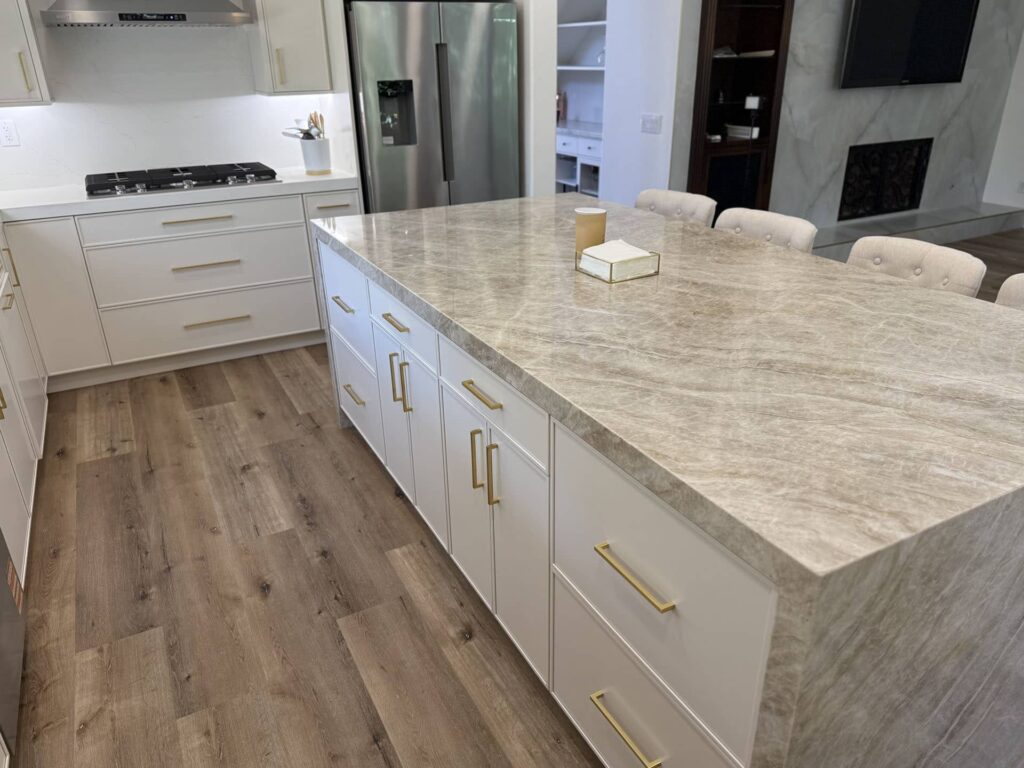
Whether you’re planning a full [kitchen remodel in Orange County] or a focused countertop upgrade, our team will walk you through the trade-offs honestly – including the ones that don’t favor the most popular option.
Frequently Asked Questions About Granite vs Quartz Countertops
1. Can you put hot pans on granite or quartz countertops?
Granite can usually handle brief contact with a hot pan, though trivets are still smart near seams and cutouts. Quartz should never take direct heat – its resin binder can scorch, discolor, or crack. Always use trivets or hot pads on quartz.
2. Which stains more easily, granite or quartz?
Unsealed or under-sealed granite stains more easily because it’s porous. Quartz is non-porous and resists most food and drink stains without sealing, although strong pigments like turmeric or permanent marker can still mark light-colored quartz if left to sit.
3. Do granite or quartz countertops scratch easily?
Neither scratches easily. Both are harder than a typical steel knife, so normal kitchen use won’t harm them. Grit dragged under heavy cookware or unglazed ceramics can leave fine marks, and dark polished finishes show scuffs more than lighter or honed surfaces.
4. Which countertop lasts longer in a busy kitchen?
Both can last for decades with proper fabrication and care. Granite holds up better to heat and sunlight; quartz holds up better to spills and requires no sealing. The longest-lasting choice is the one that matches how you actually cook and clean.
5. Is quartz or granite easier to maintain?
Quartz is easier day to day because it never needs sealing. Granite needs periodic resealing – usually every one to three years – but tolerates heat better. If you’ll reliably use trivets, quartz is lower maintenance; if you won’t, granite may be more forgiving.
Find the Right Countertop for the Way You Live
The granite vs quartz countertops decision comes down to your daily habits. If heat and sunlight are your biggest risks, granite is the more forgiving surface. If spills and low maintenance top your list – and you’ll commit to trivets – quartz is hard to beat. Either way, quality fabrication and the right care routine matter just as much as the material itself.
Q Kitchen & Bath is ready to help you choose between granite and quartz countertops with confidence. Call us at (909) 552-9090, email info@q-kb.com, or visit us at 3135 Harbor Blvd, Suite C, Costa Mesa, CA 92626 to schedule your consultation.